
Decoding Nepali Words to Number: The Ultimate Lakh and Crore Converter Guide
Have you ever looked at a long number written out in a contract, like “Pachis Lakh Cha Hazaar,” and felt a sudden wave of confusion? You’re not alone. While converting numbers to words is common, the reverse—taking complex Nepali words and translating them back into the correct numerals—can be surprisingly tricky, especially when dealing with the unique Lakh and Crore grouping system.
Mastering the Nepali words to number conversion is essential for checking legal documents, reconciling bank statements, or ensuring you’ve correctly interpreted a formal financial amount in Nepal.
This comprehensive, step-by-step guide will simplify this process, showing you exactly how the Nepali (or Indian) numbering system works and how to convert any amount—from Das Hazaar to Dus Arab—into its numerical form accurately and quickly.
The Conversion Challenge: Why Nepali Is Different
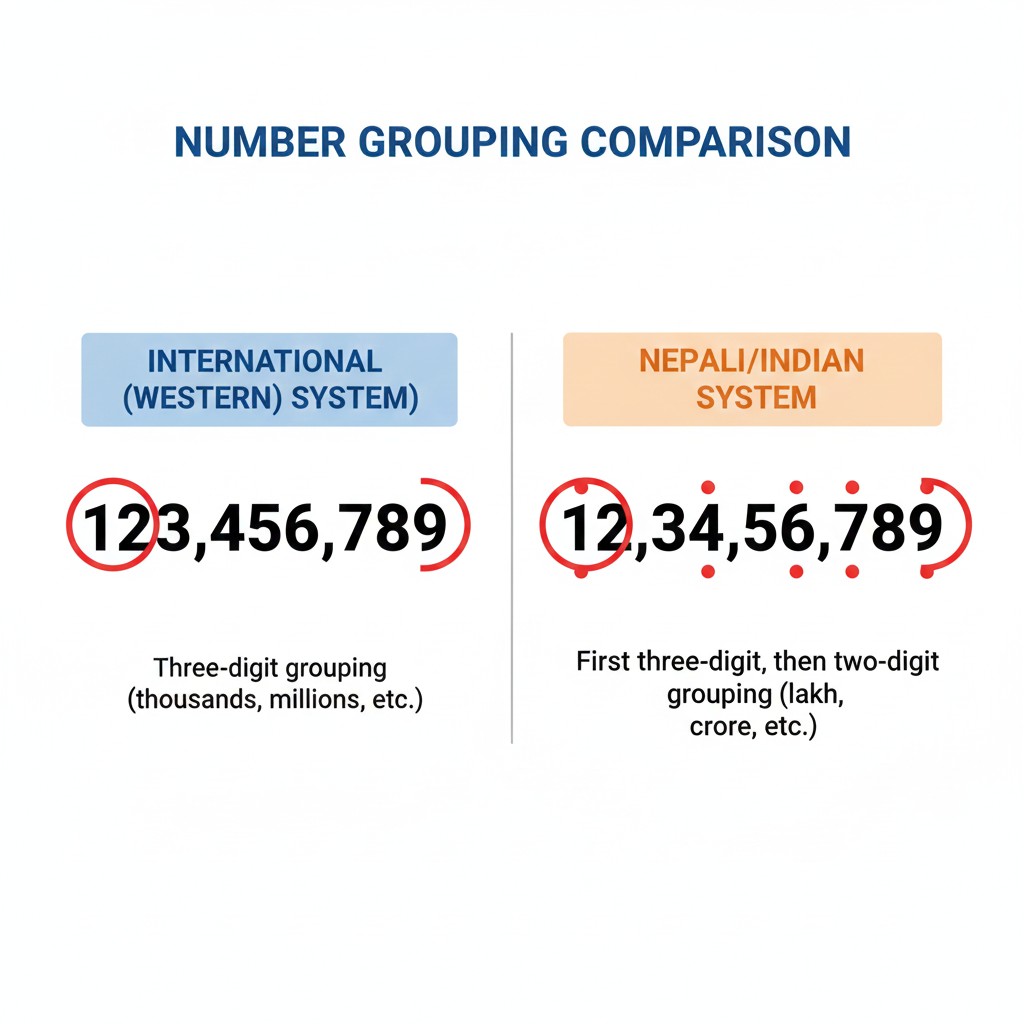
The primary difficulty when converting Nepali words to number figures stems from the fact that the Nepali system does not use the Western (International) grouping of thousands, millions, and billions. Instead, it relies on a mixed grouping pattern that uses specific terms:
The Non-Standard Grouping System
The International system groups numbers every three digits (1,000,000). The Nepali system follows a pattern of three digits first, and then groups of two.
Nepali Unit | Numerical Value | International Equivalent |
|---|---|---|
Hazaar (हजार) | 1,000 | Thousand |
Lakh (लाख) | 1,00,000 | Hundred Thousand |
Crore (करोड) | 1,00,00,000 | Ten Million |
Arab (अरब) | 1,00,00,00,000 | Billion |
This means when you hear a number in Nepali, you must assign the digits to a pair, not a trio.
4 Steps to Convert Nepali Words to Number Figures
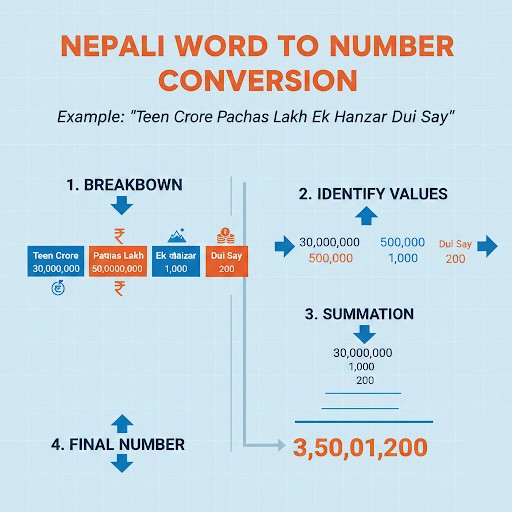
The easiest way to process a complex number written in words is to break it down by its scale (Hazaar, Lakh, Crore) and then sum the resulting chunks.
Let’s use a common example: “Teen Crore Pachaas Lakh Ek Hazaar Dui Say”
Step 1: Identify the Major Scale Chunks
Read the phrase and break it up every time you hear a major scale word (Crore, Lakh, Hazaar). The number that precedes the scale word belongs to that group.
Scale Word | Preceding Word/Number | Numerical Value |
|---|---|---|
Crore | Teen (3) | 3 |
Lakh | Pachaas (50) | 50 |
Hazaar | Ek (1) | 1 |
Base (Hundreds) | Dui Say (200) | 200 |
Step 2: Apply the Multiplier to Each Chunk
Now, multiply the numerical value by its corresponding scale.
- Crore: 3 \times 10,000,000 = 30,000,000
- Lakh: 50 \times 100,000 = 5,000,000
- Hazaar: 1 \times 1,000 = 1,000
- Hundreds: 200 (No multiplier needed)
Step 3: Combine and Align the Place Values
Align the numbers from largest to smallest, paying close attention to the number of zeros required by the Nepali grouping system.
- 3 Crore: 3,00,00,000
- 50 Lakh: 50,00,000
- 1 Hazaar: 1,000
- 2 Say: 200
Now, merge them mentally or using addition:
3,00,00,000 + 50,00,000 + 1,000 + 200
Step 4: Write the Final Figure
The final resulting numerical figure is 3,50,01,200.
Pro Tip: When a scale is skipped (e.g., Crores are mentioned, but Lakhs are not), always insert two zeros (00) in its place to maintain the grouping structure. For example, “Two Crore, Five Thousand” is 2,00,05,000.
Real-Life Scenarios: When Accuracy Matters
The need to accurately convert Nepali words to number often arises in high-stakes situations where errors can be costly, both legally and financially.
1. Verifying Bank Statements and Receipts
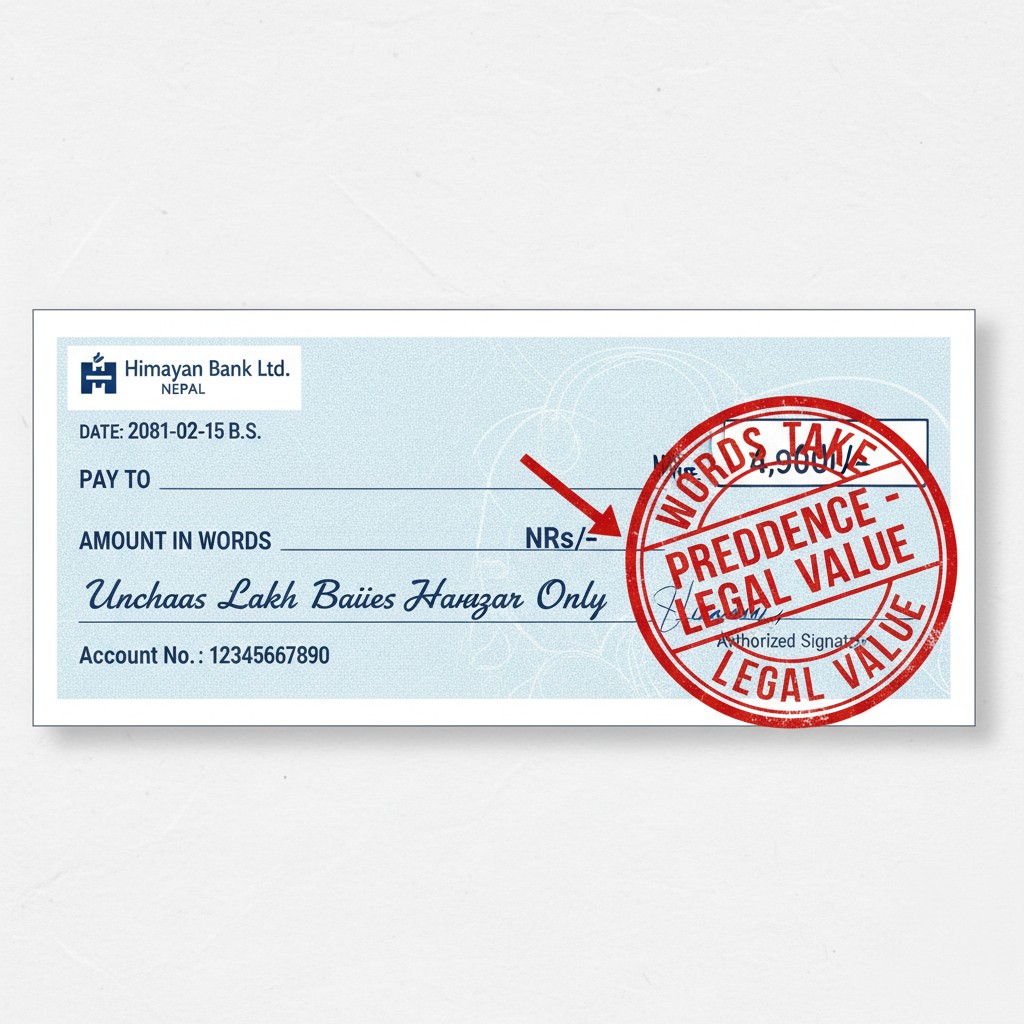
Imagine receiving a bank receipt detailing a large transaction. The amount in words might read: “Unchaas Lakh Baaies Hazaar Aath Say Pachattar.”
If you misinterpret ‘Unchaas Lakh’ (49 Lakh) as ‘Forty-Nine Thousand’ (a common error when mixing systems), you could believe the amount is 49,000 when it is actually 4,900,000. Being able to instantly convert the words ensures you validate the transaction amount correctly against your numerical ledger.
2. Interpreting Legal and Property Documents
In real estate or loan documents, the agreed-upon price is almost always written out in full words to prevent fraud. For example, a land deed might list the price as: “Chaar Crore Sattais Lakh Rupaiyaa Matra.
Mastering the Nepali words to number conversion is essential for checking legal documents, reconciling bank statements, or ensuring you’ve correctly interpreted a formal financial amount in Nepal.
- Conversion: 4,27,00,000
- Actionable Insight: If you see any deviation from the correct numerical figure (42,700,000) in the numerical box, the words take precedence, but the error must be corrected immediately by the notary/lawyer.
3. Working with Mixed Language Documents
In Nepal, it’s very common to see mixed-language inputs, such as using English words for the smaller numbers but Nepali scale terms for the large groups (e.g., “Twenty-Three Lakh”). A reliable conversion tool or system must be able to recognize both:
- Input: “Twenty-Three Lakh Five Thousand”
- Output: 23,05,000
Advanced Conversion: Handling Decimals and Zeroes
What about amounts that involve paise (pice)?
In a financial context, the decimal point separates the whole rupees (Rupaiyaa) from the paise (which are counted as hundredths, 1-99).
- Example Words: “Pachas Hazaar Duirupaiyaa Ra Sattar Paisa Matra” (Fifty Thousand Two Rupees and Seventy Paisa Only)
- Main Number (Rupees): Pachas Hazaar Duirupaiyaa \rightarrow 50,002
- Decimal Part (Paisa): Sattar Paisa \rightarrow .70
- Final Number: 50,002.70
This method of separation ensures clarity and is crucial for transactional accuracy.
The Importance of the Zero (Shunya)
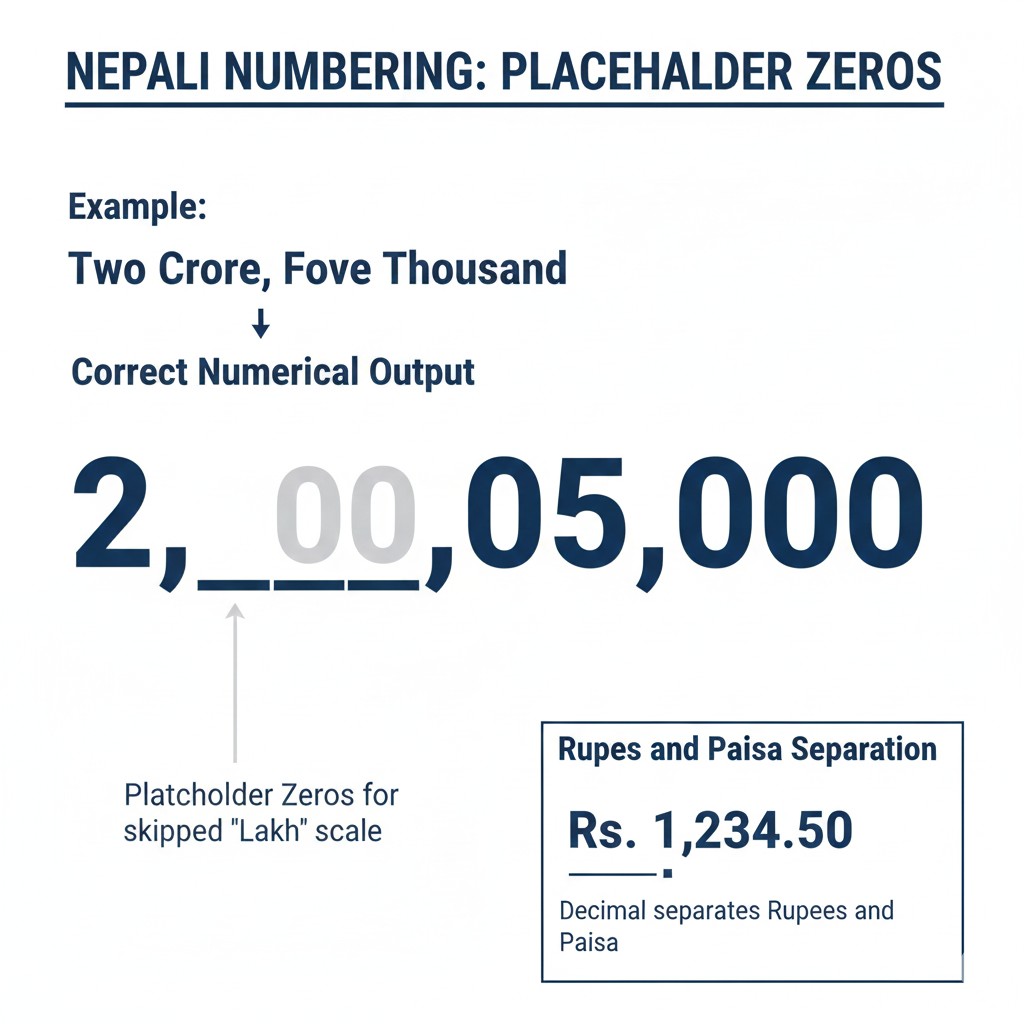
The zero is arguably the most important digit in Nepali words to number conversion because it holds the place of a skipped scale.
- If the words skip Hazaar (e.g., Das Lakh, Chaar Say), you must insert a pair of zeros for the thousands place (10,00,**00**,400).
- If the words skip Lakh (e.g., Ek Crore, Dus Hazaar), you must insert a pair of zeros for the Lakhs place (1,**00**,10,000).
FAQs
Q1: What is the biggest difference between the Nepali and International numbering systems?
A: The main difference is the grouping structure. The International system groups digits by three (thousands, millions), while the Nepali/Indian system groups digits by three first, then by two (hundreds, thousands, lakhs, crores).
Q2: Why do I need to learn the Nepali words to number conversion?
A: In Nepal, all formal financial and legal documents (like bank checks, contracts, and property deeds) legally prioritize the amount written in words over the numerical figure. Knowing the conversion ensures you can verify and interpret official amounts correctly and prevent fraud.
Q3: How much is one crore in USD or the International system?
A: One Crore (1,00,00,000) is equivalent to Ten Million (10,000,000) in the International system.
Q4: What should I do if a scale word is missing, like “Lakh” is skipped?
A: If a scale is skipped, you must insert a pair of zeros (00) in its place when writing the number. For instance, “Two Crore, Five Thousand” is written as 2,00,05,000.
Q5: Can I use an online tool for Nepali words to number conversion?
A: Yes, reliable online tools are highly recommended for complex or large sums. They can instantly process phrases and ensure accuracy against the Lakh and Crore scale rules. If you need a fast conversion, you can use our dedicated [Nepali Number to Words tool] for instant results.
Conclusion:
The journey of converting Nepali words to number figures might seem confusing at first, but it is entirely systematic. The secret lies not in individual words, but in consistently applying the first-three, then-two grouping rule associated with Lakh and Crore.
By meticulously identifying the scale words, multiplying the preceding digits, and aligning them correctly, you gain absolute control and clarity over any formal financial figure. This expertise is a crucial step towards ensuring your financial security and confidence in the Nepali context.
Don’t let the words confuse you—master the numbers today!