
The Essential Guide to Converting Nepali Numbers to Words: Lakh, Crore, and Beyond
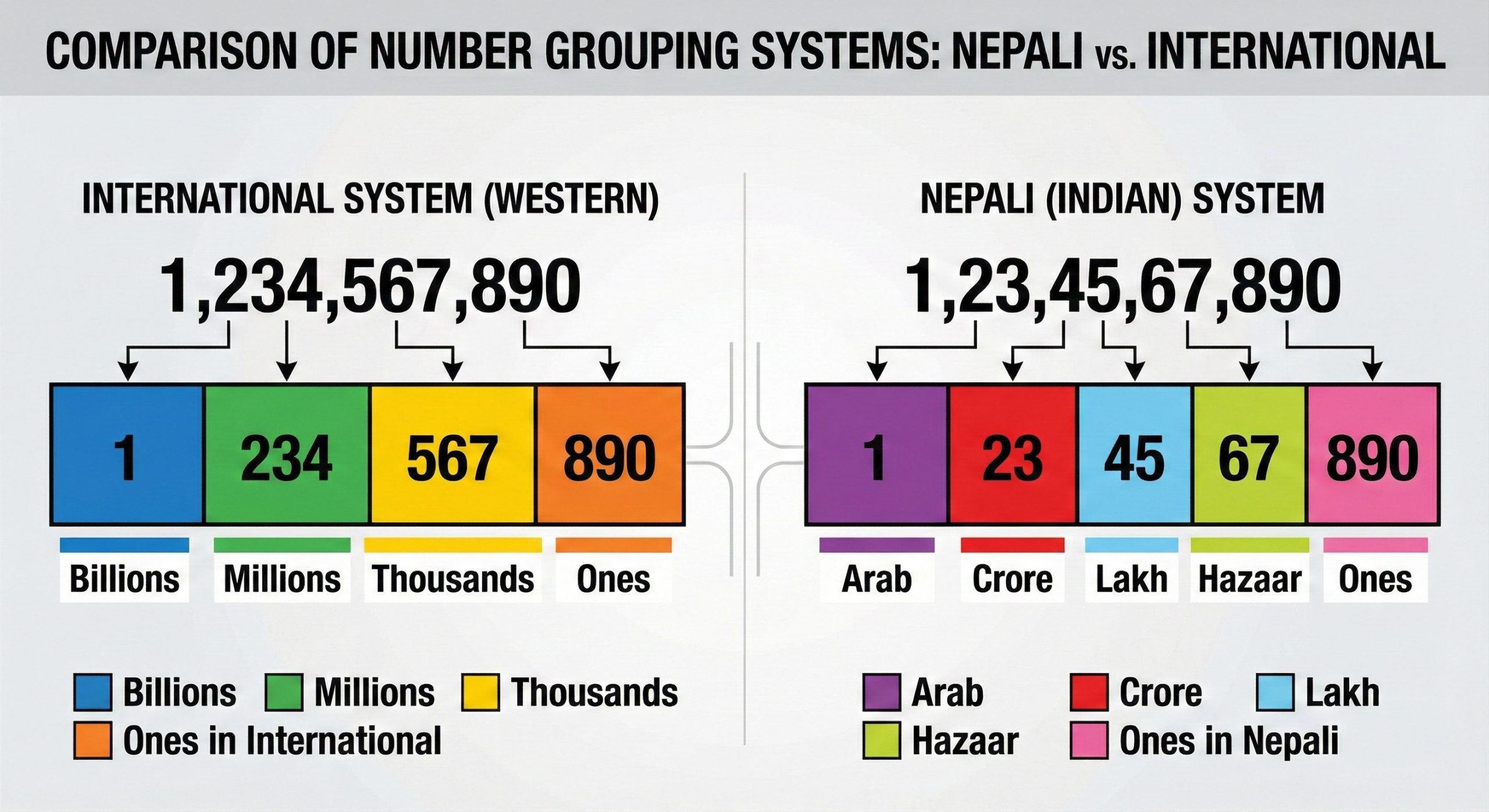
Have you ever struggled to write a large number on a Nepali bank check, wondering where the commas go and what the right words are? You are not alone. The Nepali numbers to words conversion system, which follows the traditional Indian numbering system, is fundamentally different from the International (Western) system most often taught in schools.
Understanding how to properly write 1,00,000 as “One Lakh” and 1,00,00,000 as “One Crore” is crucial for formal documents, financial transactions, and clear communication in Nepal and the broader South Asian region.
This comprehensive guide will break down the Nepali Numbers to Words system, help you master the conversion process, and ensure your financial documents are always correct.
The Core Difference: Nepali vs. International Numbering
The biggest hurdle for anyone converting Nepali numbers to words is the grouping structure. While the Western system uses a three-digit grouping pattern (thousands, millions, billions), the Nepali system, based on the Lakh/Crore structure, mixes two-digit and three-digit groupings.
The Grouping Pattern
Digits (From Right) | International System Grouping | Nepali System Grouping |
|---|---|---|
First 3 Digits | Thousands (3, 6, 9, 12…) | Hundreds (3) |
Remaining Digits | Threes (e.g., millions, billions) | Twos (Lakhs, Crores, etc.) |
This means a number is punctuated as follows:
- International: 10,000,000 (Ten Million)
- Nepali/Indian: 1,00,00,000 (One Crore)
Notice the commas: the first comma is after the three hundreds digits, and all subsequent commas are after every two digits.
Key Nepali Place Values
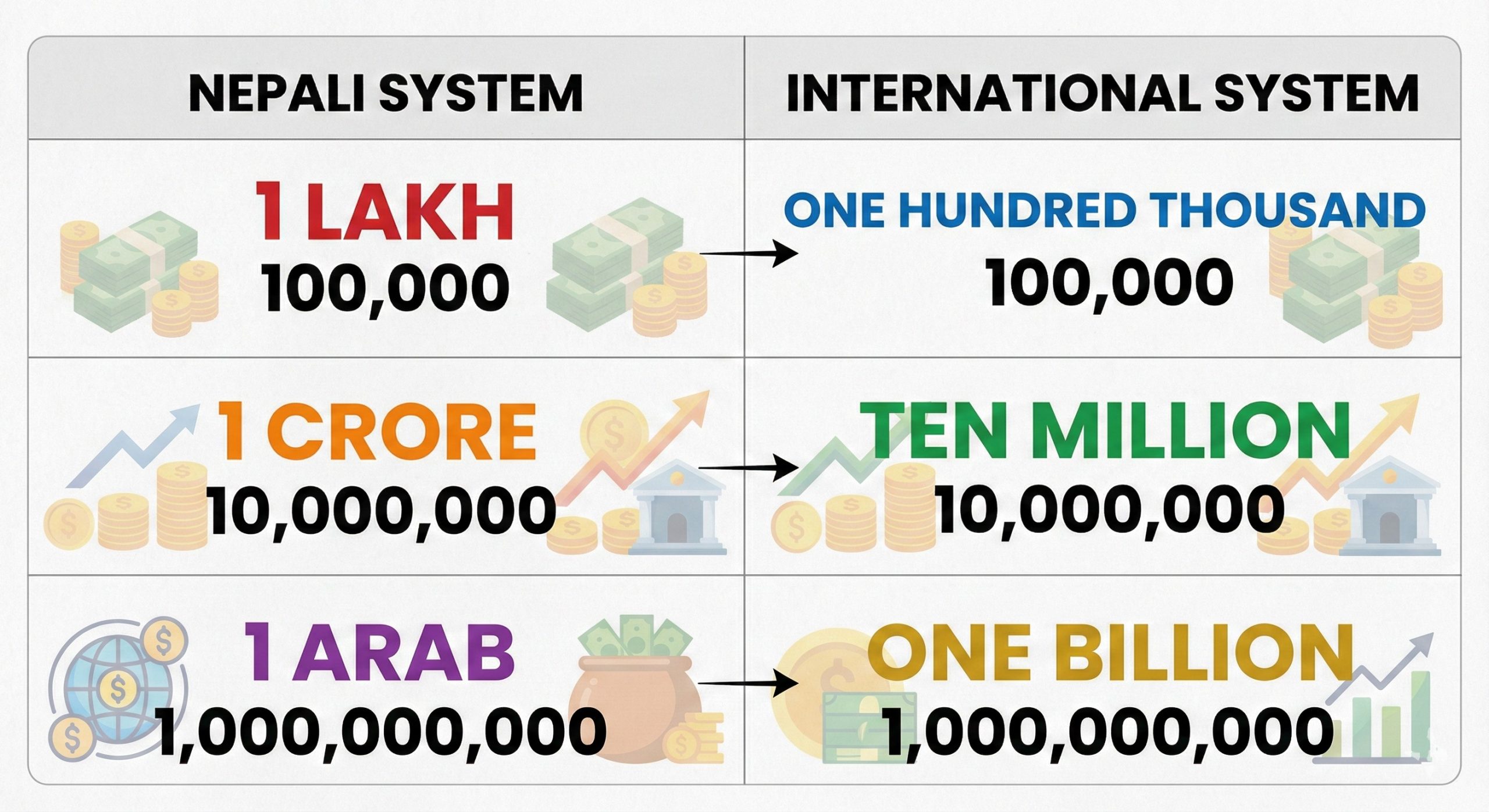
To convert any Nepali numbers to words, you must first memorize the main units that replace ‘million’ and ‘billion’:
Value (Numerals) | Nepali Word | English Equivalent |
|---|---|---|
100,000 | Lakh (लाख) | One Hundred Thousand |
1,000,000 | Das Lakh (दश लाख) | One Million |
10,000,000 | Crore (करोड) | Ten Million |
100,000,000 | Das Crore (दश करोड) | One Hundred Million |
1,000,000,000 | Arab (अरब) | One Billion |
Step-by-Step Conversion: From Numbers to Nepali Word
Mastering the conversion process is simple once you apply the correct grouping logic. Let’s use a real-life example: NPR 5,23,45,678.90.
Step 1: Punctuate the Number Correctly
First, break the number down using the Nepali comma rule (first three, then groups of two):
5,23,45,678
Step 2: Identify the Group Units
Now, label each section of the number starting from the right:
- 5 (Crore)
- 23 (Lakh)
- 45 (Thousand)
- 678 (Base 100)
Step 3: Convert Each Unit to Nepali Words
Convert the numerical value of each group (5, 23, 45, 678) into the correct Nepali word, starting with the largest unit (Crore):
- 5 Crore: Pāñca karoḍa (पाँच करोड)
- 23 Lakh: Teisa lākha (तेइस लाख)
- 45 Thousand: Paĩtālīsa hajāra (पैँतालिस हजार)
- 678: Cha saya sattarī (छ सय सतहत्तर)
Step 4: Assemble the Complete Word String
Combine the units together:
पाँच करोड तेइस लाख पैँतालिस हजार छ सय सतहत्तर
Step 5: Handle the Decimal (Paisa/Pice)
In financial contexts, the digits after the decimal point represent Paisa (pice). If the number was 5,23,45,678.90, the final part must include the decimal value:
- 90 Paisa: Nabbe paisā mātra (नब्बे पैसा मात्र)
Final Nepali Numbers to Words Conversion (Currency):
पाँच करोड तेइस लाख पैँतालिस हजार छ सय सतहत्तर रूपैयाँ र नब्बे पैसा मात्र
Case Study Example: Writing a formal bank check for 3,50,000.
- Number: 3,50,000
- Nepali Numbers to Words: तीन लाख पचास हजार रूपैयाँ मात्र
- English Equivalent (Lakh/Crore style): Three Lakh Fifty Thousand Rupees Only
Why is Number-to-Word Conversion Essential for Financial Security?
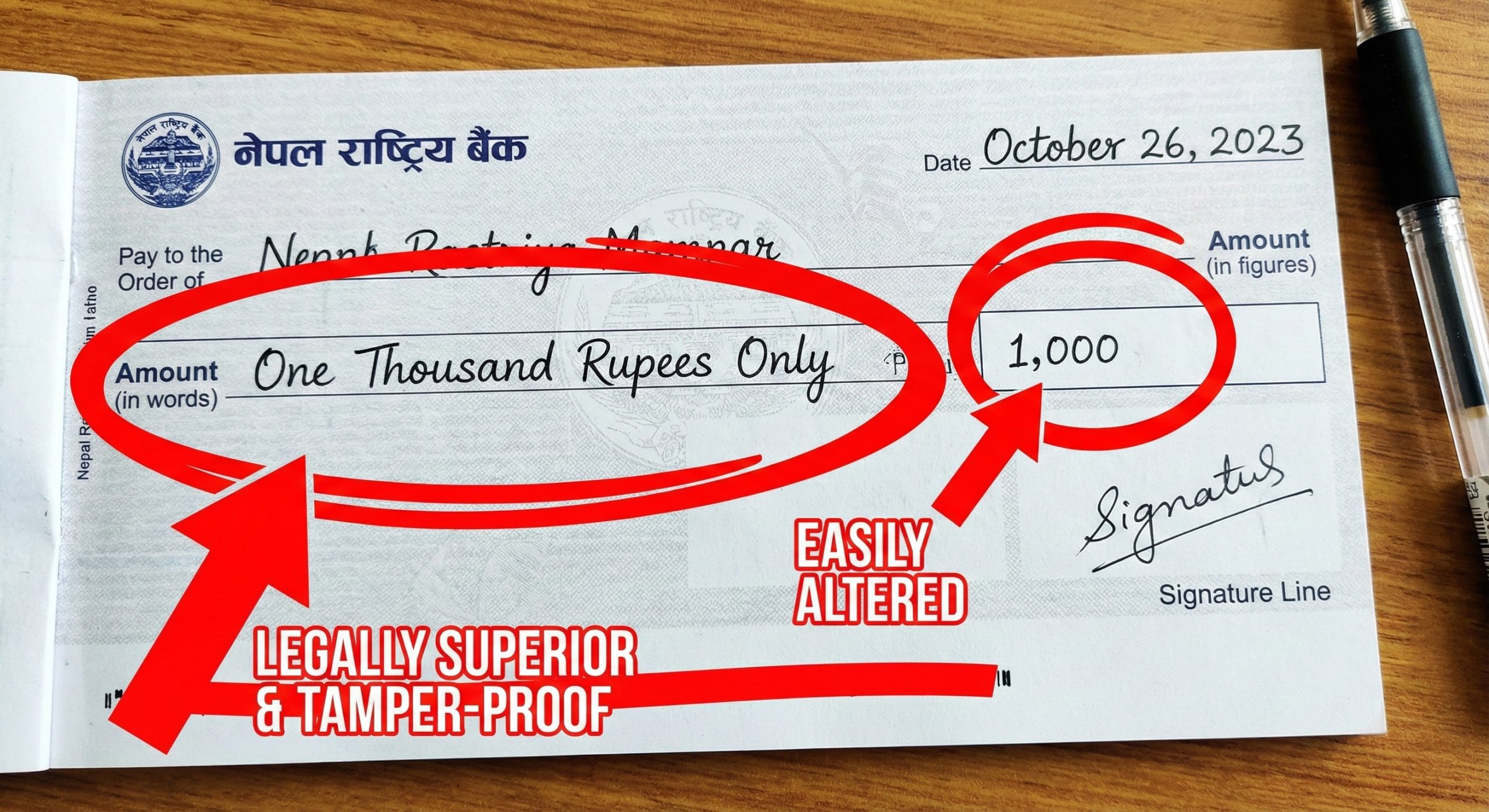
In Nepal, like in many parts of the world, writing the monetary value in words on a check or contract is a non-negotiable requirement. This practice serves a critical security and legal purpose: preventing fraud and ambiguity.
1. Security and Anti-Fraud
When writing a check, the space for the numerical value (the box where you write 5,000) can be easily altered by adding a digit (e.g., turning 5,000 into 50,000). The amount written in nepali numbers to words, however, is much harder to manipulate because adding a word or changing the sentence structure is obvious and time-consuming.
2. Legal Precedence
In banking and legal contracts, if there is a discrepancy between the numerical figure and the amount in words, the amount written in words always takes precedence. This confirms the original, intended value and minimizes legal disputes.
3. Clarity for Large Sums
It is incredibly easy to miscount zeros when dealing with large numbers like 10,00,00,000 (10 Crore). Writing the amount in the clear, grouped words eliminates any doubt about whether the figure is 1 Crore, 10 Crore, or 100 Crore.
Common Mistakes to Avoid
The mixed system of the Nepali/Indian numbering method is the source of almost all conversion errors.
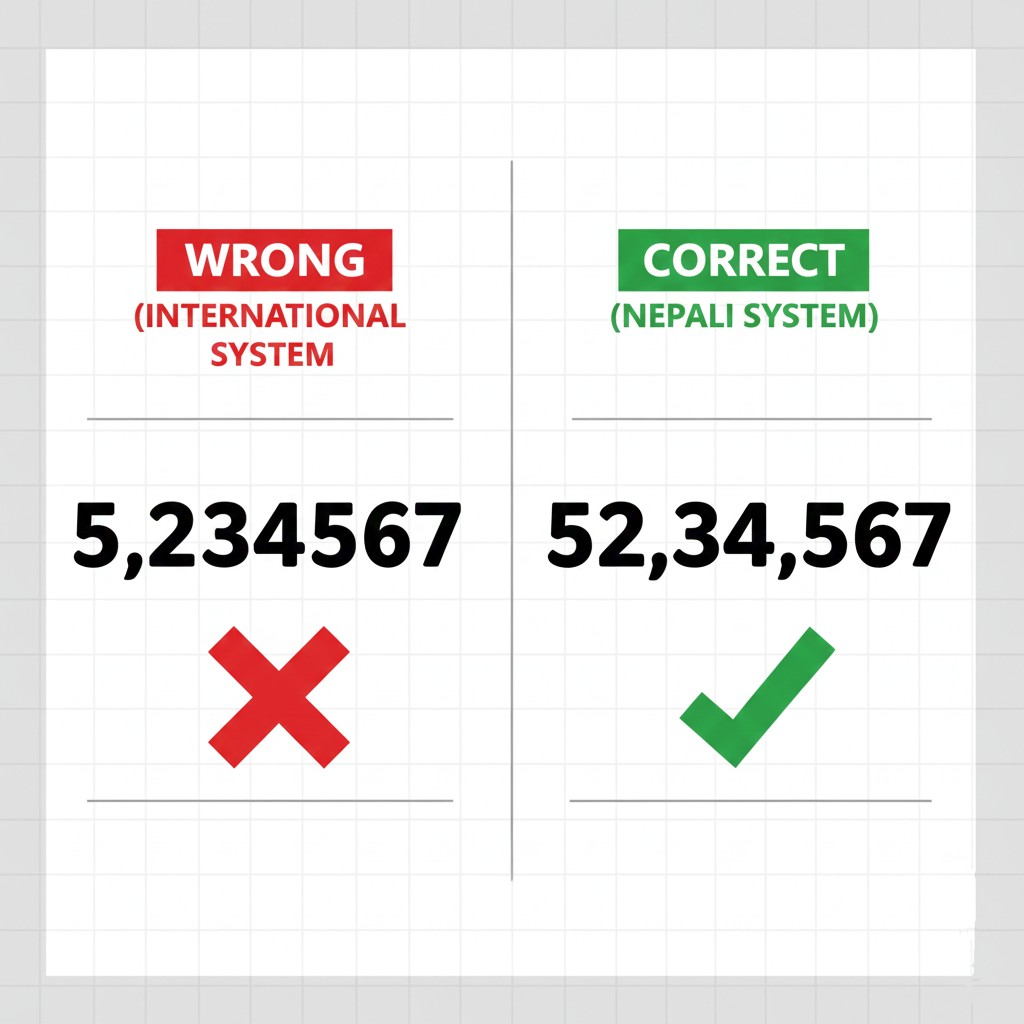
Mistake 1: Misplacing the Commas
The most frequent error is applying the International System’s three-digit grouping throughout.
- ❌ Wrong (International): 5,234,567
- ✅ Correct (Nepali): 52,34,567 (Fifty-Two Lakh, Thirty-Four Thousand…)
Mistake 2: Confusing Lakh and Million
Always remember the difference in value. This is a common confusion when dealing with expatriates or international transactions.
Unit | Nepali Value | International Value |
|---|---|---|
Lakh (लाख) | 100,000 | 100 Thousand |
Crore (करोड) | 10,000,000 | 10 Million |
Mistake 3: Incorrect Termination
For formal currency conversions (like on a check), always end the phrase with the appropriate marker to denote finality and prevent additional words from being added later:
- Nepali: …रूपैयाँ मात्र (Rupees Only)
- English (on a Nepali check): …Rupees Only
FAQs
Q1: How do I write 1 Lakh in Nepali words?
A: The number 1,00,000 is written as एक लाख (Ek Lākha). In English (Lakh/Crore style), it is “One Lakh.”
Q2: What is the Nepali word for 1 Billion?
A: One billion (1,000,000,000) is one hundred crore. The standard Nepali term for this is एक अरब (Ek Arab).
Q3: When converting currency, how is the decimal part written?
A: The whole number (before the decimal) is converted using Lakh/Crore and is followed by रूपैयाँ (Rupees). The decimal part (the cents/paisa) is written as a number (0-99) followed by पैसा मात्र (Paisa Only).
- Example: 1,500.25 is एक हजार पाँच सय रूपैयाँ र पच्चीस पैसा मात्र (One Thousand Five Hundred Rupees and Twenty-Five Paisa Only).
Q4: Can I use the International numbering system on Nepali bank documents?
A: While the International system (millions, billions) is generally understood, it is strongly advised to use the official Nepali/Indian system (Lakh, Crore) on all formal and financial documents, such as bank checks, contracts, and revenue forms, to ensure compliance and avoid processing delays.
Conclusion
Mastering the Nepali numbers to words conversion is a simple, yet essential, skill for anyone living or conducting business in Nepal.
The key is to abandon the Western three-digit grouping (1,000,000) and adopt the South Asian system of grouping first by three, then by two digits (10,00,000).
Whether you are signing off on an investment, receiving a salary, or simply paying a vendor, always remember the power of Lakh and Crore to ensure your figures are clear, legal, and secure.
Need to convert a large amount quickly? Use a reliable online Nepali numbers-to-words converter to check your work instantly, especially for check writing, and practice with large numbers until the Crore grouping becomes second nature.