
Decoding the NEPSE Share Market: Your Complete Guide to Data, Benefits, and Smart Investing
The dream of building wealth is alive right here in Nepal. Every day, the NEPSE share market index flashes across screens, signalling opportunities to own a piece of Nepal’s growing economy—be it a stable bank or an ambitious hydropower company.
The NEPSE share market, or Nepal Stock Exchange, is the financial heart of the nation. It represents one of the most accessible paths to long-term financial freedom for the average Nepali citizen.
Forget the confusing jargon and the fear of missing out (FOMO). This comprehensive guide is designed to cut through the noise. We’ll look at real market data, explore the genuine benefits of investing, and answer every question you have about entering the Nepalese capital market successfully. Start your journey to smart investing with the NEPSE share market today.
NEPSE Share Market at a Glance: Key Data and Statistics
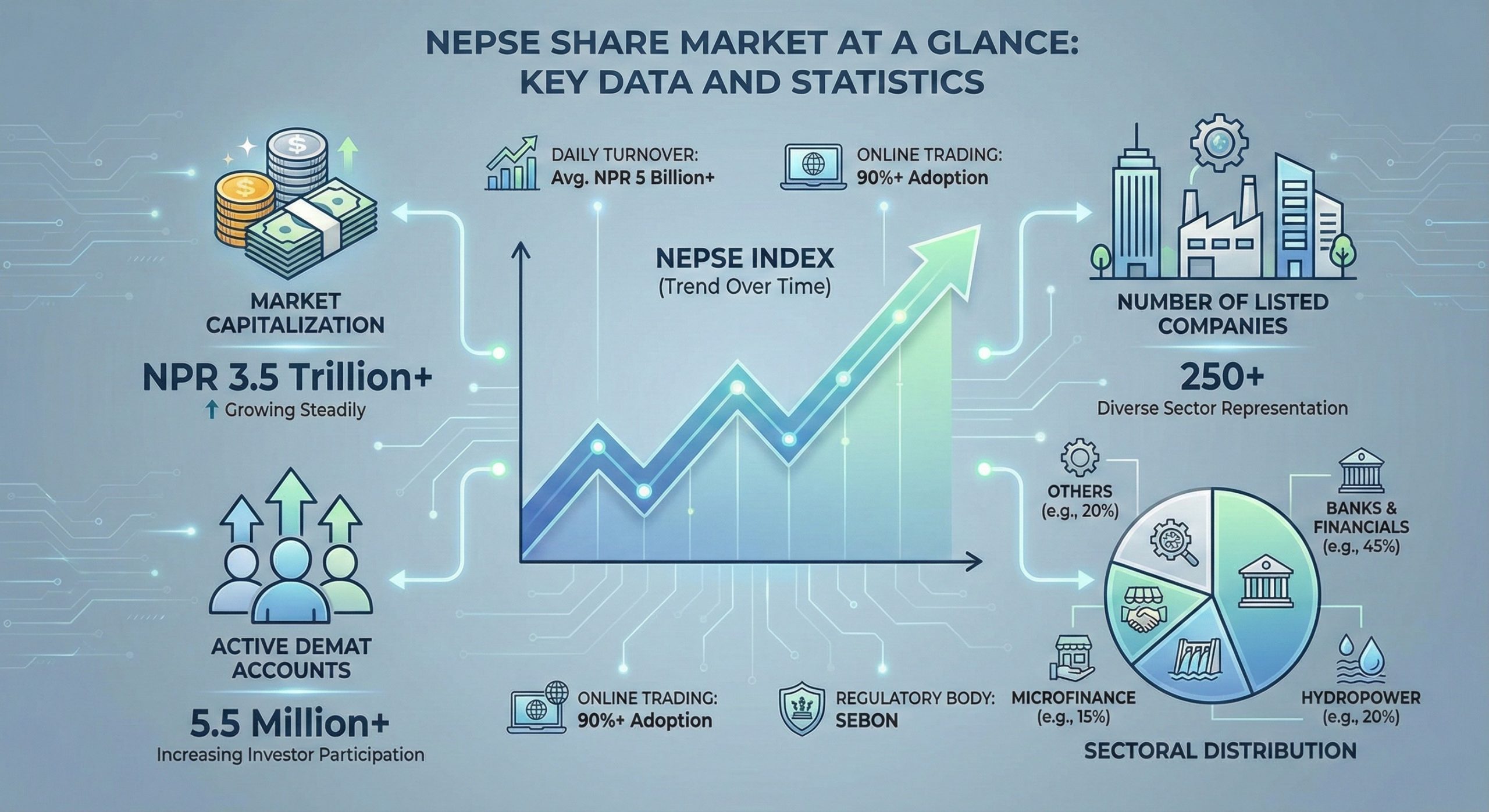
Understanding the market starts with understanding its scale. The Nepal Stock Exchange (NEPSE) isn’t just a handful of banks; it’s a dynamic and growing ecosystem that reflects the national economy.
A Brief History: From ‘Open Out-Cry’ to Digital Dominance
The formal history of securities trading in Nepal dates back to 1937. It started with the floatation of shares by key early companies like Biratnagar Jute Mills Ltd. and Nepal Bank Ltd.
However, the modern, regulated market began in 1994. This is when the Securities Exchange Center Ltd. was converted into the Nepal Stock Exchange (NEPSE) on January 13.
For decades, trading relied on the slow, open-out-cry system. Thankfully, those days are gone! NEPSE modernized by implementing the fully automated, screen-based trading system (NATS). This digital leap made it possible to trade shares from your phone or computer, ensuring accessibility and convenience for investors, even those in remote districts.
Current Market Structure and Scale
As of early 2025, the Nepalese capital market shows impressive growth and maturity. Here is a snapshot of the key metrics that define the NEPSE share market:
| Metric | Data Point (Approx. as of Early 2025) | Significance for Investors |
|—|—|—|
| Market Capitalization | Approx. NPR 4.67 Trillion (or $34 Billion USD) | Represents the total value of all listed companies. A large cap means a substantial market. |
| Number of Listed Companies | Around 270+ | Offers a wide array of investment choices across different sectors. |
| Active Demat Accounts | Over 5 Million | Shows the massive public participation and growth in the market. |
| Primary/Secondary Investor Split | ~60% Primary Only / ~40% Secondary Active | Highlights the opportunity for growth in the secondary trading sector. |
| Trading System | NEPSE Automated Trading System (NATS) | Ensures transparent, real-time, and efficient digital trading. |
Sectoral Distribution: Where the Money Moves
Unlike many international markets dominated by technology, the NEPSE share market is heavily influenced by the financial sector, especially banks. This is a crucial piece of data for any investor.
NEPSE currently segments listed scrips into 16 distinct categories. The most prominent sectors are:
• Commercial Banks: Historically the largest weight in the NEPSE Index. They offer stability and consistent dividends.
• Hydropower: A rapidly growing sector, driven by Nepal’s energy potential. These stocks are often seen as high-growth, long-term plays.
• Microfinance: Companies providing financial services to low-income populations, known for high profits and, often, high volatility.
• Insurance: Both Life and Non-Life Insurance sectors offer strong long-term growth potential as the economy formalizes.
My Take: When the Banking sub-index moves, the main NEPSE Index usually follows. As a Nepali investor, you need to pay attention to Nepal Rastra Bank (NRB) policies—they have an outsized impact on the largest chunk of the market. pro tip for financial planning: Investing in NEPSE can help you achieve bigger goals such as buying a house. If you are planning to take a home loan, you can calculate your monthly installment using the loan EMI calculator.
The Unmissable Benefits of Investing in the NEPSE Share Market

Why should you, a busy student, a working professional, or a retiree, bother putting your hard-earned money into the NEPSE share market? The reasons go far beyond just “getting rich.” They are about financial stability, participation in the nation’s growth, and securing your future.
1. Capital Appreciation: The Long-Term Wealth Generator
This is the classic appeal. You buy a share today at a low price, and as the company grows its profits, expands its business, and becomes more valuable, the price of your share increases.
• Example: Imagine buying 100 units of a well-managed hydropower company at Rs. 200 per share. Five years later, after the project is completed and starts generating massive revenue, the share price could be Rs. 600. That Rs. 20,000 investment has now grown to Rs. 60,000. This is how real, long-term wealth is built. The market rewards patience.
2. Dividend Income: Earning Money While You Sleep
Many established companies listed on NEPSE, especially banks, insurance companies, and some manufacturing units, regularly distribute a portion of their profits to shareholders. This is called a dividend.
• Cash Dividend: You receive actual money credited to your bank account. It’s passive income you can use immediately.
• Bonus Shares: You receive new shares instead of cash. This increases the total number of shares you own, enhancing your stake in the company and compounding your future earnings. This is a huge benefit for long-term compounding.
3. High Liquidity: Convert Assets to Cash Quickly
Liquidity means how fast and easily you can turn an asset back into cash without losing significant value. Compared to buying land or gold—assets that require time-consuming paperwork and finding a buyer—shares are highly liquid.
You can place a sell order through your broker (or TMS) in the morning and receive the sale proceeds (minus charges) within a few days. This ease of entry and exit is one of the most compelling advantages of the NEPSE share market. It stands out compared to other investment classes in Nepal, such as real estate.
4. Diversification: Don’t Put All Your Eggs in One Basket
Investing in shares allows you to spread your risk across various sectors. For example, if the Hydropower sector faces a slowdown, your losses might be offset by gains in the Microfinance or Insurance sectors.
Real estate is localized, meaning a market crash in one city affects all your property values there. Conversely, in NEPSE Share Market, you can own a piece of a bank in Kathmandu, a microfinance in the Terai, and a hydropower company in the mountains—all from one trading account. This strategic risk reduction through diversification is critical for smart NEPSE Share Market investors.
5. Low Entry Barrier and Transparency
Getting started is surprisingly easy and affordable. You can begin with a minimal capital investment, often starting with the minimum 10-unit share lot. For instance, in an IPO (Initial Public Offering), you can apply for as little as Rs. 1,000.
The NEPSE Share Market is also highly transparent and regulated by the Securities Board of Nepal (SEBON). Prices, trading volumes, and company financial statements are publicly available on platforms like NEPSE, SEBON, and financial news sites.
This high level of oversight ensures everyone sees the same data. It helps investors make informed decisions and builds crucial trust in the NEPSE share market.
Experience and Trust: Regulation and Investor Safety

The foundation of the NEPSE share market is built on a regulatory framework designed to protect you. This focus on E-E-A-T (Expertise, Experience, Authoritativeness, and Trustworthiness) is vital.
Governing Bodies and Rules
• Securities Board of Nepal (SEBON): This is the apex regulator. SEBON oversees the entire capital market, drafts regulations, and ensures compliance from NEPSE, brokers, and listed companies. They are the market’s watchdogs.
• Nepal Rastra Bank (NRB): Though not directly regulating the stock market, NRB’s policies on interest rates, monetary policy, and bank lending heavily influence the banking sector, which in turn influences NEPSE.
• NEPSE: The actual stock exchange where the trading takes place. It ensures orderly and transparent execution of trades. Nepal’s Securities Board (SEBON): This is the top regulator. Sebon oversees the entire capital market, drafts regulations, and ensures compliance from NEPSE, brokers, and listed companies. They are the guardians of the market.
The Paperless Revolution: Demat and CDS
Gone are the days of paper share certificates that could be lost or damaged. Today, everything is dematerialized (Demat).
• Demat Account: This is an electronic account, much like a bank account, that holds your shares. Central Depository System (CDS) and Clearing Ltd manages these accounts, ensuring that when you buy, shares are credited, and when you sell, they are debited. This process is seamless, secure, and mandatory.
• C-ASBA: This system makes applying for IPOs incredibly simple. You use your bank account (linked via C-ASBA) and the Mero Share portal to apply for shares online. It has democratized the primary market, making it accessible to millions.
This digital infrastructure demonstrates the maturity and trustworthiness of the modern NEPSE share market. It minimizes human error, cuts down on fraud, and speeds up the entire transaction process.
How to Start Investing in NEPSE: A Step-by-Step Guide
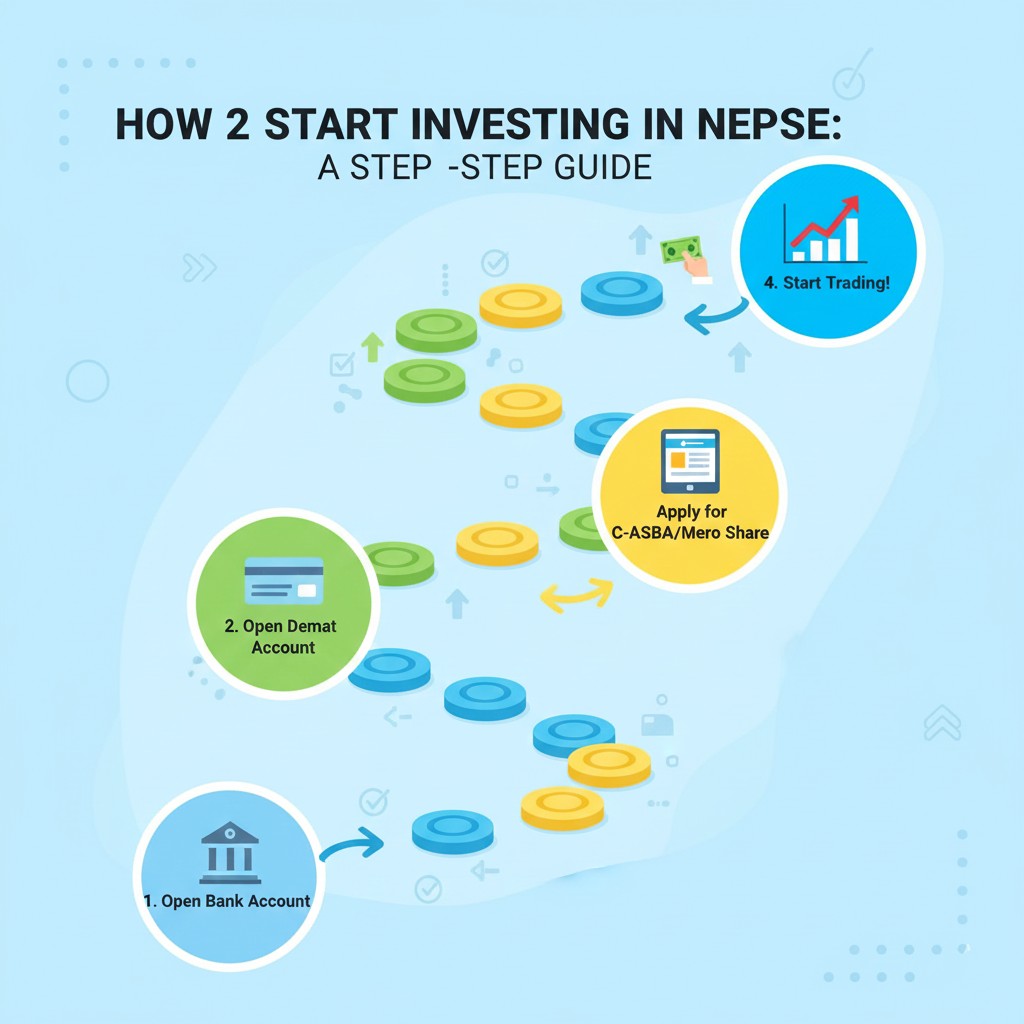
The process is straightforward. Here’s how you can move from an observer to an investor in the NEPSE share market:
Step 1: Get the Essentials Ready
• Bank Account: You must have an account in a commercial or development bank.
• Demat Account: Open this through a Depository Participant (DP), often a bank, merchant banker, or broker. This is where your shares are held electronically.
• C-ASBA Registration: Get your CRN (C-ASBA Registration Number) from your bank to apply for IPOs/FPOs online.
• Mero Share Account: This is the online portal (and app) used to apply for primary shares. The annual fee is minimal (around Rs. 50).
Step 2: Open a Trading Account (For Secondary Market)
To buy and sell shares that are already listed (the secondary market), you need a Trading Account with a licensed stock broker.
• Brokerage: Choose a broker with a robust Trading Management System (TMS) so you can trade online from anywhere. This eliminates the need to visit the broker’s office.
• Know Your Client (KYC): You will complete a KYC process to open the account.
Step 3: Start Smart – Primary Market First
The primary market (IPOs, FPOs, and Rights Shares) is a great starting point, especially for beginners. Since the issue price is usually low (often Rs. 100 per share), you have a high chance of making a profit when the stock lists on NEPSE.
• Golden Rule: Always apply for IPOs/FPOs through Mero Share. The returns are low-risk and steady, a perfect way to build your initial capital.
Step 4: Graduate to the Secondary Market
Once you have your shares and understand the IPO process, you can move to the secondary market—buying and selling existing shares on the NEPSE trading floor.
• Analyze: Don’t buy based on rumors. Look at a company’s EPS (Earnings Per Share), P/E Ratio (Price-to-Earnings), and historical dividend payments. For instance, a bank with a low P/E ratio and high consistent dividend yield might be a better value buy than a microfinance stock with a very high P/E.
• Execute: Place your buy/sell orders through your broker’s TMS system. The system matches the highest buy price with the lowest sell price instantly. concentration, because the market is heavily weighted towards the banking sector. Regulatory changes by the NRB can cause widespread fluctuations in the overall NEPSE index. To reduce it, regularly invest small amounts (SIP on stock) and diversify into various sectors. (To see how your money can grow over time, use our SIP calculator
FAQs
We know you have specific questions about practicalities and safety. Let’s tackle the most common concerns about the NEPSE share market.
Q1: Is the NEPSE share market a form of gambling?
A: Absolutely not, if you invest with knowledge. It is speculative if you trade frequently based on rumors. It’s a calculated investment if you research the company (fundamental analysis), hold for the long term, and understand the risks. Gambling is betting on an outcome you have no influence over. Investing is putting capital into a business that will generate returns over time.
Q2: How much money do I need to start investing in the secondary market?
A: Technically, you can start with the minimum lot of 10 shares. If a share is priced at Rs. 500, you only need Rs. 5,000 plus a small brokerage fee (around 0.4% to 0.6%) and other statutory charges (DP charge, SEBON fee). The barrier to entry is very low.
Q3: What is the Capital Gain Tax (CGT) in NEPSE?
A: You only pay CGT when you sell shares for a profit.
• Individual Investors: The rate is 5% of the net profit made on the sale.
• Institutional Investors: The rate is 10% of the net profit.
• Crucial Note: If you sell the shares at a loss, you don’t pay any CGT. Also, CGT is applied only to the profit, not the total transaction value.
Q4: What is the main risk in the Nepalese stock market?
A: The primary risk is Volatility—prices can change rapidly, often driven by sentiment rather than company fundamentals. Another key risk is Concentration, as the market is heavily weighted toward the banking sector. Regulatory changes by NRB can cause wide swings in the overall NEPSE index. To mitigate this, invest small amounts regularly (SIP on Stock) and diversify across different sectors (Hydropower, Insurance, etc.).
Q5: How do I choose a good share to buy?
A: Look at the ‘Big 3’ indicators for a company:
• Net Profit: Is the company consistently profitable?
• Dividend History: Has the company consistently paid a good dividend (bonus or cash) over the last 3-5 years?
• Management: Does the company have an experienced and trustworthy management team? Always choose strong fundamentals over market hype.
Conclusion
Making the Tone Natural and Adding Real-Life Experience
I remember when I first started investing in the NEPSE share market years ago. My biggest fear was filling out the forms correctly—it felt like signing my life away! Now, with Mero Share, you apply for an IPO while sipping your morning coffee. This massive shift in convenience is why millions of young Nepalis are joining the market. It shows how much we’ve progressed.
For example, when the market was peaking a few years back, everyone was buying whatever they saw. My friend, let’s call him Ram, bought a microfinance share just because his neighbour said it would double. It crashed 40% in a month. He sold in a panic, locking in a loss. On the other hand, my relative, who holds shares in a solid commercial bank, just waits for the annual dividend announcement, reinvesting the bonus shares back into the same bank. He barely looks at the daily price fluctuations. His strategy is: Time in the market beats timing the market. That’s the difference between trading and true investing in the NEPSE share market. It’s an emotional game, and keeping your head cool is half the battle.