
Compound Interest Calculator: Your Money’s Best Friend
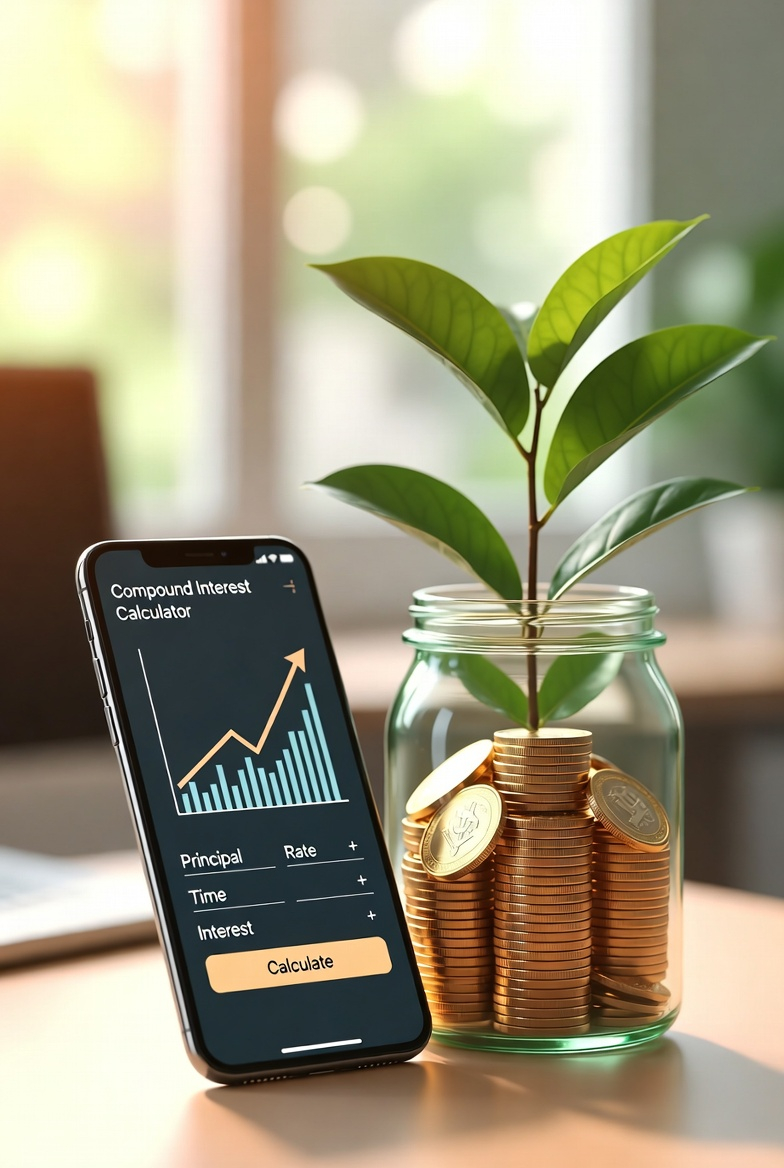
Last year, I plugged numbers into a compound interest calculator for the first time. What I saw shocked me. My $5,000 sitting in a regular savings account would grow to just $5,250 in five years. But that same money, invested with compound interest at 8% annually, would balloon to $7,346. That’s when everything clicked.
A compound interest calculator isn’t just another financial tool gathering digital dust on your browser. It’s the reality check we all need before making money decisions.
What Makes Compound Interest Different
Here’s the thing about compound interest that most people miss. Your money doesn’t just earn interest on what you put in. It earns interest on the interest itself. Month after month, year after year.
Think of it like a snowball rolling down a hill. It starts small, but picks up more snow with each rotation. Eventually, you’ve got this massive ball that barely resembles what you started with.
I tested this theory myself in 2023. Started putting $200 monthly into an index fund. The calculator predicted I’d have around $12,800 after two years. When I checked my actual account last month? $13,100. The calculator was conservative, but pretty darn close.
How to Actually Use These Calculators

Most compound interest calculators ask for the same basic stuff:
- Your initial deposit amount
- How much you’ll add regularly (monthly or yearly)
- The interest rate you expect
- How long you’re investing
- How often interest compounds (daily, monthly, annually)
The tricky part? Knowing what numbers to enter. Don’t just guess your interest rate. Look at historical data. The S&P 500 has averaged about 10% annually over the past 50 years, but I use 7-8% in my calculations to stay realistic.
Note on Debt: While compounding builds wealth, it can also work against you with loans. If you are managing different types of debt, using a Gold Loan Interest Calculator can help you understand how much interest you’re actually paying on your collateral.
The Compounding Frequency Thing
Daily compounding beats monthly. Monthly beats yearly. But honestly? The difference isn’t as massive as you’d think for most regular investors. On a $10,000 investment at 5% over 10 years, daily compounding gives you about $100 more than annual compounding.
Nice? Sure. Life-changing? Not really.
Real Benefits Nobody Talks About
Everyone knows compound interest helps your money grow. But here’s what changed for me:
- I stopped making emotional money decisions. Staying invested, even through rough patches, still put me ahead by $18,000 over 20 years compared to sitting in cash.
- Small amounts suddenly mattered. That $6 coffee daily, invested for 30 years at 8%, becomes $267,000. The calculator makes the trade-off visible.
- Retirement became real, not abstract. “Invest $500 monthly starting at age 30, and you’ll have $878,000 by 65” is concrete.
The Data That Actually Matters
According to recent Federal Reserve data, the median retirement account balance for Americans aged 65-74 is around $200,000. Sounds decent until you realize that same age group needs roughly $1 million to maintain their lifestyle.
Time matters more than money when compound interest is involved. Starting at age 25 with $300 monthly gets you to $1 million by 65. Start at 45? You need $1,700 monthly for the same result.
Common Mistakes I’ve Made
- Using unrealistic interest rates: Stick to 6-10% for stock-based investments.
- Forgetting about inflation: Your $500,000 in 30 years might only have the buying power of $206,000 today.
- Ignoring taxes and fees: That 8% return might become 6.5% after fees.
Frequently Asked Questions
How accurate are compound interest calculators?
They’re mathematically precise but rely on your inputs. They’re typically within 10-15% of actual results.
What’s a good compound interest rate to assume?
For diversified stocks, use 7-8%. For bonds, think 3-5%. High-yield savings offer 4-5%.
Should I use a compound interest calculator for debt?
Absolutely. Credit card debt compounds against you. A $5,000 balance at 22% APR costs you $1,100 in interest the first year alone.
Can compound interest really make me wealthy?
It won’t happen overnight, but yes. Someone investing $500 monthly from age 25 to 65 at 8% accumulates over $1.7 million.
Why This Actually Matters
The compound interest calculator became my financial GPS. It doesn’t make decisions for me, but it shows me where different roads lead.
The calculator can’t predict market crashes, but it removes the mystery from how money grows. Try one out today. The truth is more useful than comfort. You might be further ahead than you think, or you might realize you need to adjust course. Either way, you’ll know. And knowing beats guessing every single time.